Before you choose a bin location
Private space first, questions early
Find the spot
Identify a private-property option
Check ownership
Do not guess the municipal boundary
Confirm rules
Ask about any municipal-land proposal
Arrange delivery
Agree the position and vehicle access
Planning illustration. Municipal instructions and site-specific permissions take precedence.
Save this illustrated checklist (SVG)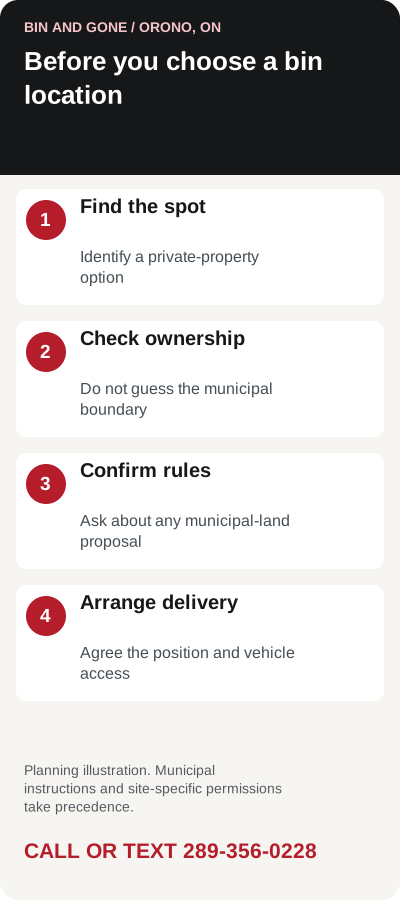
The roadway rule is not a parking rule
An empty space beside the curb does not establish permission to leave a waste bin there. The municipality's current Occupying our Roadway page specifically addresses waste bins, separately from ordinary vehicle parking. Its guidance says bins and construction equipment must not be stored on the road, including overnight.
For an Orono clearout, start this check before booking rather than hoping the driver can find a place on arrival. A missed placement arrangement can interrupt your helpers, deliveries and project schedule. The most useful first question is whether you have a workable private-property location, not which parking space is nearest to the front door.
A road occupancy permit is not blanket bin permission
Clarington also describes a road occupancy permit process for work in the municipal highway, including the sidewalk and boulevard. That process should not be read as an automatic exception to the waste-bin road-storage restriction. A permit application and an approved, site-specific arrangement are not the same thing.
If you are considering municipal land, describe the exact spot, purpose and dates directly to Clarington. Ask what is allowed for that location and which permissions are required. Do not rely on a neighbour's project or a generic guide from another municipality. This article explains how to plan the inquiry; it does not determine permission for your property.
Check the boundary of the space you want to use
A paved area or a patch of grass beside your driveway may look like part of your property without being entirely private. The visible curb and sidewalk are not a reliable substitute for checking the proposed placement. If you are unsure about the boundary, clarify it with the property owner and municipality before agreeing on the location.
This also matters for a rental home, shared drive or Main Street shop. A tenant may have access to a space without authority to place a bin there. Obtain the relevant property permission and disclose shared access arrangements to the provider. Do not treat customer parking or another tenant's loading space as an available rental-bin location.
- Identify the exact position, not just the street name.
- Check whether the area is private or municipal.
- Obtain the property owner's permission where required.
- Ask Clarington directly about any municipal-land proposal.
Keep a private-property plan practical
Even on private property, the spot needs review for the actual delivery vehicle and bin. Explain gates, turns, overhead obstructions, surface concerns and anything that must remain accessible. The business needs to consider the approach as well as the final position; an area can hold a bin without offering suitable delivery access.
Reserve space for people using the property and for the work you intend to do. Do not block a doorway or plan a loading route that depends on walking through traffic. If you cannot find a workable position, discuss a different disposal arrangement before the project starts rather than improvising an unapproved roadside location.
Use photographs to explain, not to grant approval
A useful photo set shows the approach from the road, the proposed footprint, nearby entrances and the route out. Describe where you want the bin in your message. Avoid sending only a close-up of an empty corner because it may hide the access problem that the provider needs to understand.
Keep the municipal confirmation and the provider's placement arrangement with your booking details. If the proposed location changes, review it again. Confirmation for one position should not be assumed to cover another. Do not begin occupying municipal land on the strength of a message asking whether it might be allowed.
Arrange the rental after the location is clear
Once you have a workable position, contact Bin and Gone with the Orono address, material list, preferred rental dates and the access notes. The business can discuss the suitable bin and the customer-loaded rental without a last-minute dispute about where it should go. Delivery is subject to an individually confirmed arrangement.
The approved package is $563.87 CAD including HST for the 1 ton minimum, seven days, delivery, pickup and fuel. Each additional ton is $226 including HST. These rental inclusions do not grant municipal permission, establish extra permit costs or replace any conditions required for the specific site. Call or text 289-356-0228 to discuss the plan.
Questions before you book
Can I leave the bin on the street overnight?
Clarington's published roadway guidance says overnight road storage is not permitted. Do not book an Orono rental around that assumption. Discuss a suitable private-property location instead.
Is a boulevard automatically an acceptable bin location?
No. Its ownership, the proposed work and site-specific municipal requirements need checking. Ask Clarington directly and confirm the delivery arrangement; this article is not permission to use municipal land.
Compare all five bin profiles, review the rental price, check material acceptance and plan delivery access.
Sources and how this guide was prepared
Written for Orono, Ontario using the published Bin and Gone rental offer and the official references below. Check the linked authority for current municipal rules. Project examples and checklist graphics are planning illustrations, not completed customer jobs or engineering advice. Actual materials, access, bin availability and booking terms require confirmation.
Business rates: Bin and Gone rental pricing. Loading responsibilities: rental information.